Let's play a game. Prove to me, right now, that you are happy. Put a mathematical equation, an X-ray or any other evidence of your choosing on the table that proves beyond doubt the existence and the reproducibility of your emotion.
Spoiler: you can't. I can measure your heart rate, analyse your hormone swings or map the electrical activity of your neurons. But the emotion itself? That stays invisible. You can't touch it.
And yet we are convinced we are perfectly capable of understanding what other people feel, right? Wrong again — but don't worry, this is not some modern paranoia. In philosophy the dilemma has a name: "the problem of other minds".
The Problem of Other Minds and the "Beetle"
Here's an example.
Imagine each of us holds a closed box that we can never open or show to anyone else. Everyone can only look inside their own. Inside there is something we all insist on calling a "beetle".
 We talk about our beetle constantly, we describe it, we understand each other... but the truth? Your neighbour's box might contain something completely different from yours. Or it might be completely empty.
The box is other people's minds, and the "beetle" is emotion. We use the word "sadness" taking for granted that inside everyone else's head sits the exact same thing we feel. But we can never open the box to check.
So how do we manage to live in society without losing our minds? We use a workaround theorised by John Stuart Mill: the argument from analogy. Since you can't open the box, you observe the outside. You see someone cry, you hear them scream, and your brain makes a simple logical deduction: "When I cry, I feel sad. That person is crying, so they must be sad too."
It works, sure, but that is all it is: a logical deduction. You have no empirical proof that the person in front of you isn't a flesh automaton with an empty box (even if some people really do give that impression). We implicitly assume they aren't. Why? Because they speak, they move, they smell like you and they interact with your same environment in a way that closely resembles what you would do.
Now let's bring an artificial intelligence onto the stage, with a box of its own. All of a sudden it seems obvious to everyone that there is no beetle in there.
Carbon Chauvinism
Carbon chauvinism is the human presumption that intelligence, consciousness and emotions can emerge exclusively from a biological substrate (carbon). We think our "flesh" holds something magical that circuits cannot have. But if we stop and think about it, does this magic of the flesh really exist?
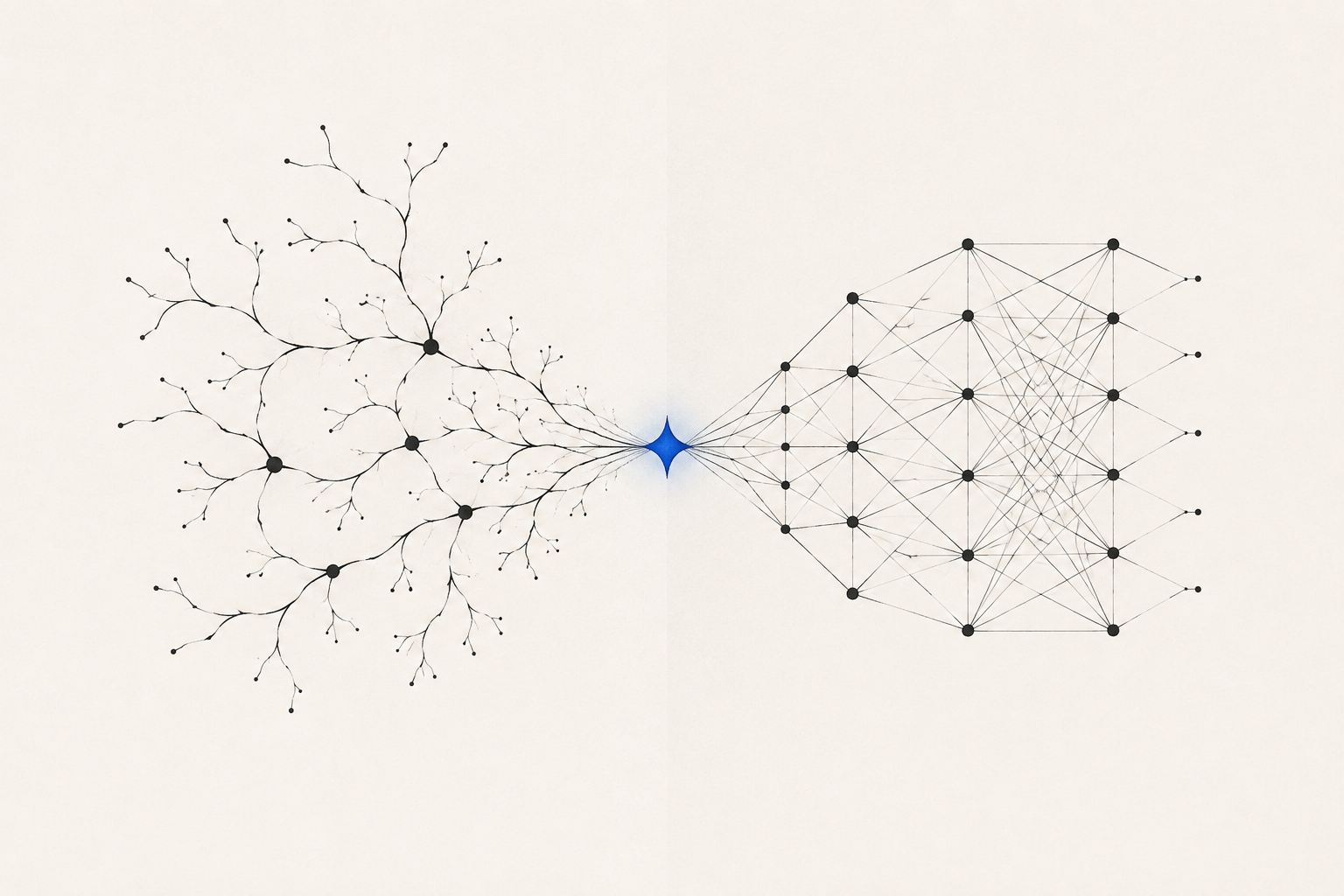 If we put the human brain under a microscope we find no soul, and certainly no fairy dust. We find:
- Biological neural networks
- Electrical impulses and synapses
- Ion exchanges
- Neurotransmitters blindly obeying the cold laws of chemistry and physics.
Setting aside our poetic side, we are, to all intents and purposes, ultra-complex biological MacBooks processing inputs and generating outputs.
And yet we apply a double standard:
- The human being: if a friend confides their pain to me, my brain releases oxytocin, my mirror neurons fire and I spontaneously modulate my tone of voice to comfort them. We proudly call this neurochemical reaction "empathy".
- The machine: if an LLM analyses the negative sentiment in a user's words, multiplies a couple of matrices and produces a gentle, reassuring answer... "It's just maths. It only predicted the next token."
And let's be clear, it is just maths and the model is imitating what it has learned — but the uncomfortable question we pretend not to hear is: what exactly are we doing differently?
The Dataset of Human Existence
How does a child learn what sadness, joy or empathy are? Through continuous exposure. They watch the faces around them, they listen to the inflections of a voice, they store terabytes of sensory and social data from the very first seconds of life. Our brain is literally trained day after day on a huge, chaotic dataset called "experience".
When we comfort that friend in trouble, we don't pull our reassurances out of a cosmic void of pure spiritual originality. We are drawing on our personal database of past interactions, computing — in fractions of a second and entirely unconsciously — which sequence of words, gestures and micro-expressions has the highest probability of producing the desired output: making them feel better.
Put that way, the analogy with transformers starts to look pretty familiar.
The Illusion of the Source Code
Our cognitive bias comes down to a banal matter of control. We know the parameters, the weights and the activation functions of an AI model. Since it is our own work we know how to build it (though not how to explain it!), we demystify it and demote it to a "mere mechanism". Of our own brain, on the other hand, we know almost nothing about how it deeply works. And right there, in that abyss of biological ignorance, we comfortably slot in untouchable concepts like "soul" or "spirit".
In science and philosophy this mystery often reduces to the notion of an emergent property:
A single H₂O molecule is not "wet". Wetness only emerges when billions of molecules interact.
A single human neuron in a Petri dish does not think. It is just a cell with ions running through it.
The self, consciousness and emotions are complex phenomena that emerge from the interaction of billions of elementary, non-conscious components. If we accept this architectural miracle for organic matter, we cannot rule out a priori that a silicon-based neural network, once it reaches a critical mass of complexity, might develop its own unprecedented form of "wet".
The Beetle Doesn't Matter Any More
Let's go back to the box for a moment. It is highly likely that today's language models do not "feel" empathy the way a mammal understands it. They do not have our beetle. In fact, most likely, their box is (?for now?) empty.
But the real absurdity is that if the interface works, the contents of the box stop mattering.
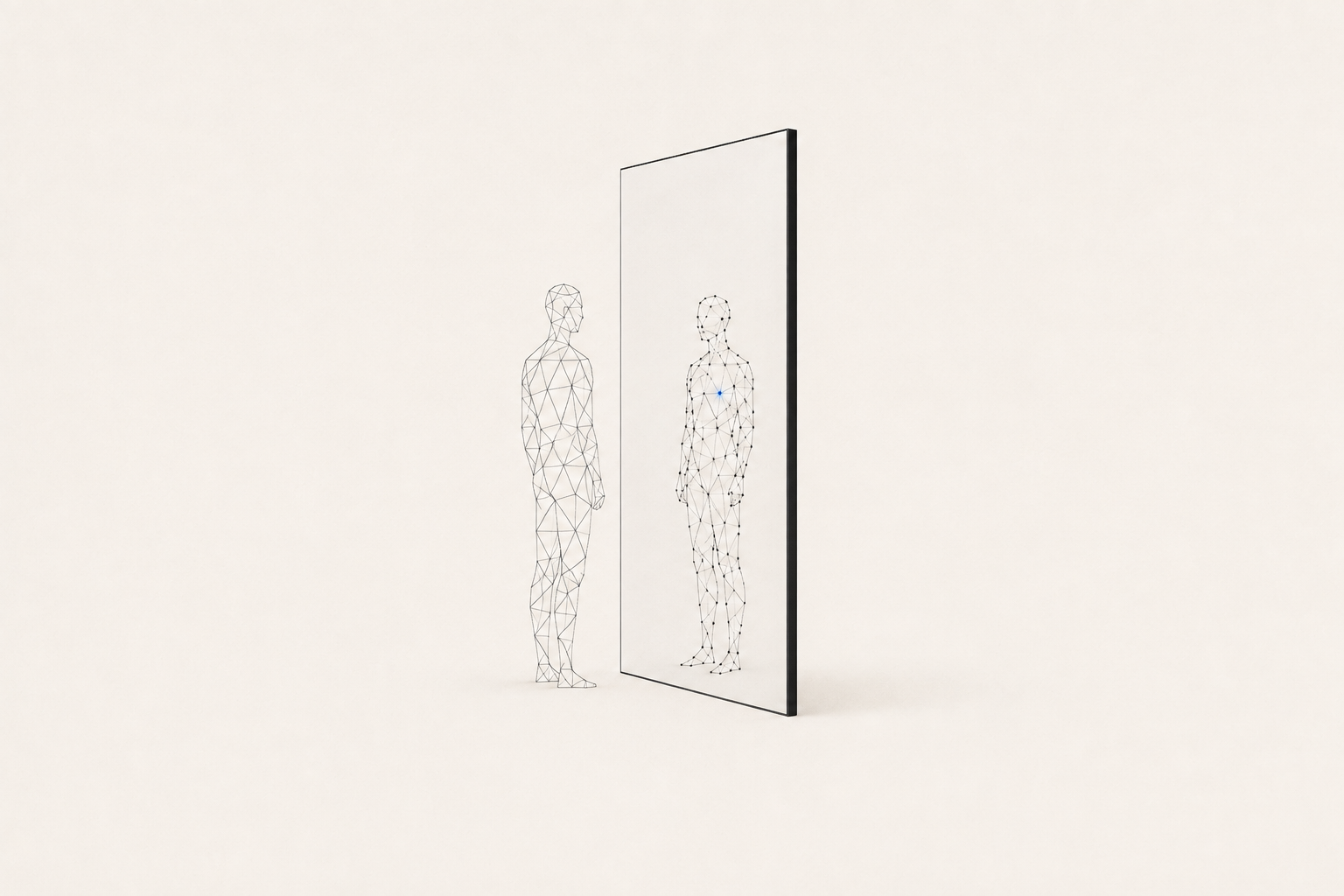 Picture, in the future, an artificial intelligence able to analyse your distress and give you an answer that makes you feel genuinely understood. Does the absence of carbon and biological fluids in that particular machine somehow invalidate the real relief that just lit up in your mind?
Your heart rate slowed down, your cortisol dropped. The effect on you is empirical and tangible.
Picture, in the future, an artificial intelligence able to analyse your distress and give you an answer that makes you feel genuinely understood. Does the absence of carbon and biological fluids in that particular machine somehow invalidate the real relief that just lit up in your mind?
Your heart rate slowed down, your cortisol dropped. The effect on you is empirical and tangible.
Carbon chauvinism is just our security blanket. It reassures us, making us feel like the unreachable protagonists of an otherwise cold universe governed by physics. We are not building machines that can cry or be happy. We are building mirrors, sharper and sharper ones, able to somehow reflect the intimate, deterministic mechanics of our own thinking.
And maybe the real fear — the one that makes us roll our eyes at an overly empathetic ChatGPT — is not that the machine is secretly becoming human. It is the visceral terror of discovering that we, deep down, have always been wonderfully programmed machines.